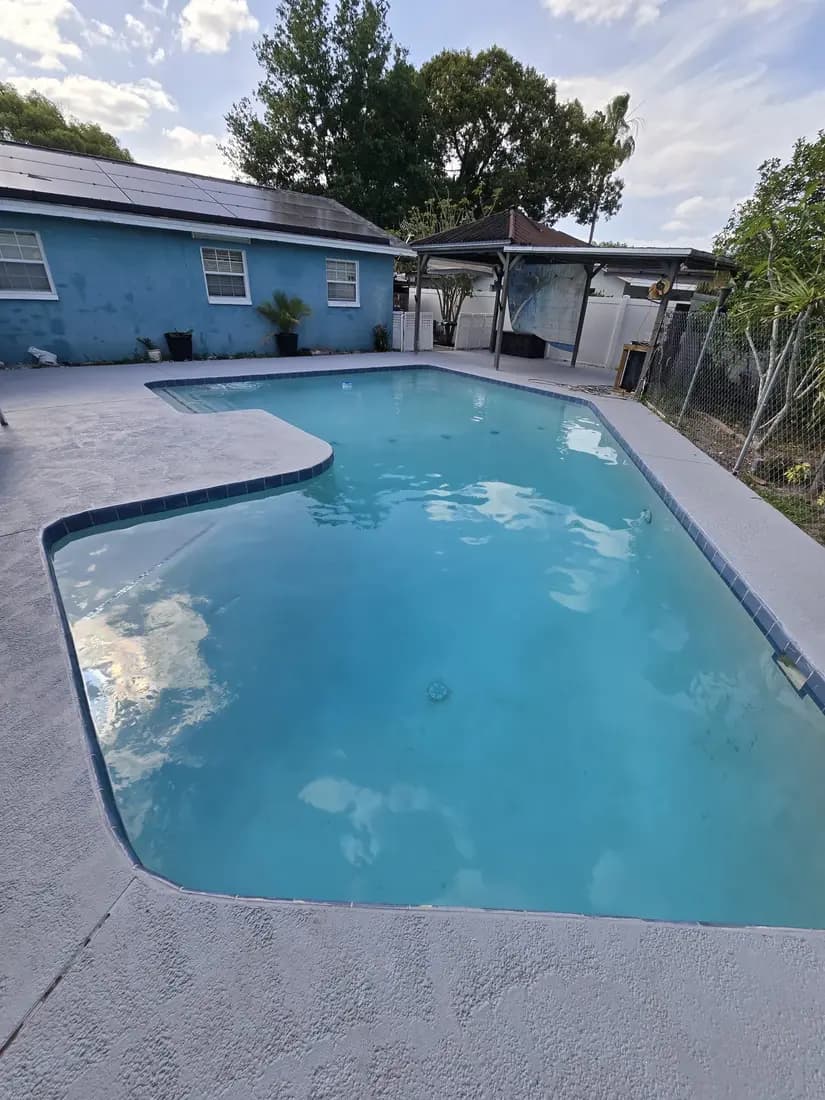
Salt Water Pool Service in Orlando, FL
Specialized cleaning and salt system care that keeps salt water pools clear, balanced, and easy on your equipment.
Salt Water Specialists
Salt Pools Aren't Chlorine-Free — They're Chlorine-Smart
A salt water pool doesn't skip chlorine — it makes its own. A salt chlorine generator pulls dissolved salt from the water and converts it into chlorine as it passes through the salt cell. It's a great system when it's working right, but it only works right when the cell is clean, the salt level is in range, and the surrounding water chemistry is balanced.
That's exactly where most salt pools get neglected. Owners are told salt pools are “set and forget,” and for a while that seems true — the water looks fine, the system hums along. But the cell slowly scales up on the inside where you can't see it, chlorine output quietly drops, and one day the water turns cloudy or green seemingly out of nowhere. By the time that happens, you're not just dealing with a chemistry problem — you may be dealing with a damaged cell that needs replacing.
Our salt water service is built around the part of the pool most companies skip: the salt system itself. Every visit includes a full pool cleaning plus the inspection and maintenance that keeps chlorine production steady, so the pool stays clear year-round instead of surprising you with a green Saturday morning.
What's Included
Complete Salt Water Pool Service
Every visit covers a full pool cleaning plus the salt-system care that keeps chlorine production steady.
The cell is the part of the system doing all the work, and it's also the part almost nobody looks at. We check it directly rather than just trusting the readout on the control panel, because a cell can be scaling up internally long before the panel throws a warning.
Why It Matters
Why Salt Water Pools Need Specialized Care
Salt chlorine generators push pH upward over time as a natural byproduct of how they produce chlorine. Left unchecked, that rising pH drives alkalinity out of range and deposits calcium scale on your cell, tile, and pool surfaces — the same scale that eventually chokes off chlorine output. Salt in the water is also mildly corrosive to metal ladders, handrails, and heater components, so keeping chemistry in the right window isn't just about clear water, it's about protecting the hardware around the pool.
Florida makes all of this more demanding, not less. Near-constant swimming and intense year-round sun burn off stabilizer (cyanuric acid) faster than in most climates, meaning chlorine breaks down in sunlight quicker if stabilizer isn't replenished. Central Florida's naturally hard water also accelerates calcium scaling on salt cells compared to most of the country. A salt pool here isn't a lower-maintenance option by default — it needs attention on a real, consistent schedule to actually deliver on that promise.
Salt Cell Health at a Glance
| Sign | What It Usually Means | What Happens If Ignored |
|---|---|---|
| "Inspect Cell" or "Check Cell" warning | Scale buildup or a wiring/flow issue at the cell | Chlorine output drops, water can turn cloudy or green |
| Low-salt reading | Salt level below the system's operating range | Cell can't produce enough chlorine, even if it's "running" |
| High-salt reading | Over-salted water, often from over-correction | Faster corrosion of metal fixtures and equipment |
| Cloudy water with system "running" | Cell scaled internally, output silently reduced | Algae growth despite the system appearing normal |
| Rising pH / scale on tile | Byproduct of chlorine generation, not being offset | Scale on cell plates, rough tile, cloudy water |
| Corrosion on ladders or rails | Chemistry out of balance for an extended period | Costly equipment and fixture replacement |
This is the part of salt pool ownership that catches most people off guard: the system can look like it's working — lights on, panel green — while the cell underneath is already losing capacity.
Common Salt System Issues
Problems We Catch Before They Turn Your Pool Green
Catching these early is almost always cheaper and faster than fixing them late. A cell that's mildly scaled can often be cleaned and brought back to full output. A cell that's been neglected for months may need replacing outright — which is a very different bill.
Our salt water care pairs naturally with weekly pool service and professional water treatment for ongoing maintenance, and if the salt system itself needs hands-on repair, our pool repair team can take it from there.
We Provide Salt Water Pool Service Across Central Florida
Frequently Asked Questions
Salt Water Pool Service FAQs
Is a salt water pool really lower maintenance than a chlorine pool?
How often should a salt cell be inspected?
What does "Inspect Cell" or "Check Cell" on my panel actually mean?
Why does my salt pool keep needing pH adjustment?
Can you fix a scaled or damaged salt cell, or does it need to be replaced?
Do you service salt water pools with automation systems or app controls?
Do I need to buy and add my own salt, or is that included?
Keep Your Salt System Running Right
Get specialized salt water pool service in Orlando. No contracts, free estimates.